The safest way to learn how to move a couch through a door is to measure first, clear the path, remove loose parts, and tilt the couch as you turn it. Two or more adults should guide the frame, protect walls and floors, and stop if the couch needs force or creates a pinch point.
Table of Contents
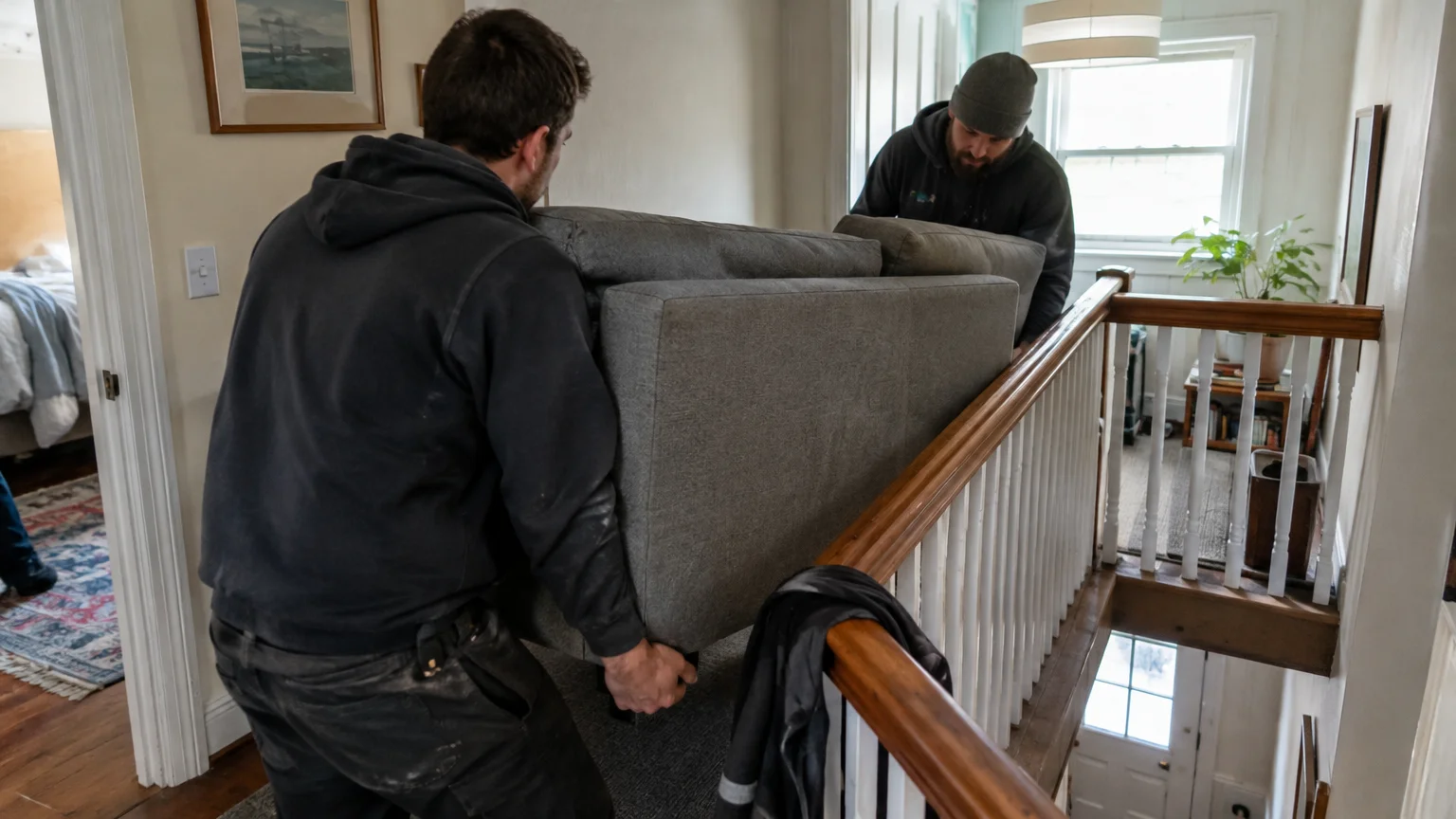
- Will the couch actually fit through the door?
- What should you do before moving the couch?
- Which direction should you angle the couch?
- How do you move a couch through a narrow doorway safely?
- How can you move a couch upstairs or around a tight corner?
- What should you do if the couch still will not fit?
- What are the key takeaways for moving a couch through a door?
Moving a large sofa is often a geometry problem, not a test of strength. A couch may fit through a doorway when turned on its side, even if its front looks too wide. Good planning helps homeowners, tenants, and office owners avoid torn fabric, scraped walls, broken trim, and back injuries. Lynchburg Movers helps customers with bulky furniture when a do-it-yourself move becomes unsafe.
Will the couch actually fit through the door?
A couch may fit through a small door if its narrowest position is smaller than the doorway and the space beyond it. The first check is not only the couch's front width. Check its height, depth, arm shape, and ability to turn inside the space.
Measure the couch, doorway, and clearance path
Measure the couch at its widest, tallest, and deepest points. Include rounded arms, feet, loose back cushions, and any part that sticks out. Then measure the door opening between the inside edges of the frame. Open the door fully, since the hinges and door slab can reduce the space.
Measure halls, stair landings, nearby walls, and turns too. A couch can pass through the doorway and still stop at the next corner. Write down each measurement. A simple sketch can show if the couch needs to enter flat, upright, or on its side.
The diagonal length may matter more than the straight width. When a couch stands partly upright, one corner can enter first while the rest of the frame swings behind it. This works only when the ceiling, walls, and nearby furniture leave room for the turn.
Account for trim, hinges, railings, and tight turns
Door trim takes away space and can catch on fabric. Hinges may block a corner, while a railing can stop the couch from turning on stairs. Measure the true opening, not just the open space around the door.
A safe plan leaves room for hands and control. A couch that technically fits with no extra space can still damage the wall or trap a hand. Lynchburg Movers can help Lynchburg homeowners review hard access points before lifting a heavy item.
What should you do before moving the couch?
Before lifting, remove items that add weight or may fall off. Clear the entire route, protect the surfaces, and choose one person to lead. Many homeowners can handle a short move when the couch is manageable, the route is open, and everyone can lift safely.
Remove cushions, legs, doors, and other detachable parts
Take off loose cushions and pack them separately. Remove couch legs if the maker allows it. Check below the couch for screws, clips, or brackets before pulling on anything. Do not cut fabric or remove a fixed frame for a small gain in space.
If a door blocks the route, remove it only if someone can support and replace it safely. Keep the screws in a labeled bag. Store each cushion and leg with the couch so nothing is lost during the move.
Protect floors, walls, corners, and the couch frame
Place moving blankets or thick pads along the route. Use corner guards on sharp wall edges. Cover wood, tile, and finished floors with material that will not slide. Do not drag a heavy couch across bare flooring, even when the floor looks strong.
Wrap the couch with moving blankets, but keep the bottom and handholds easy to grip. Stretch wrap can hold blankets in place, but do not press it hard against delicate leather or damp fabric. Remove lamps, tables, rugs, and wall art before lifting.
A clear path matters more than speed. The lead person should check the next turn before the couch moves. If the move includes stairs, narrow landings, or a very heavy frame, Loading & Unloading Help or Furniture Movers may be safer than trying alone.
Which direction should you angle the couch?
Most couches pass through a narrow doorway with a tilt-and-pivot method. This means lifting one end, turning the couch so its back or side leads, and rotating the frame in small steps. The best direction depends on the couch shape and the room beyond the door.
Use the tilt-and-pivot method
Stand the couch on one end only when its frame can safely handle that position. One person controls the higher end while another guides the lower end. Tilt the couch a little, move one corner through the doorway, and pivot around that corner without quick twists.
The back often enters first because it creates a slimmer angle than the front. In other cases, an arm must lead. Test the angle with a light tilt before making a full lift. Keep the couch close to the floor when possible, but never rest its weight on a weak arm or cushion.
Decide when to turn the couch on its side or end
Turning the couch on its side can reduce the width needed at the door. Standing it upright may help with a narrow opening, but the ceiling must be high enough. Check for fans, lights, sprinklers, and low beams before raising the frame.
Do not force the couch into an angle that bends the arms or twists the base. A soft cushion may compress, but a firm frame cannot safely shrink. The couch may need to move backward, forward, or diagonally several times before the right path is clear.
The goal is controlled movement, not maximum effort. If the couch needs repeated drops, sudden jerks, or hard pushing, stop and change the plan.
How do you move a couch through a narrow doorway safely?
Move the couch slowly, with one person giving clear directions. The lead person watches the doorway and tells the others when to lift, lower, push, or turn. Agree on simple commands before starting, such as stop, hold, lower, and turn.
Coordinate the lifting and rotating steps
Place the strongest lifter at the heavier end, but do not ask one person to carry all the weight. Lift with bent knees and a steady back. Keep the couch close to the body without pressing it into the wall. Move one small step at a time.
When the first corner clears the door, pause. Let the lead person check the upper arm, back, and lower frame. Then rotate the couch only as much as needed. The person inside the room should guide the entering end, while the person outside supports the remaining weight.
A furniture dolly may help on a flat, clear floor. Straps may improve control when used correctly, but they do not replace enough lifting help. Sliders work for short moves across smooth floors, not for lifting a couch over a step or threshold.
Keep hands, feet, and the frame clear of pinch points
A pinch point is a place where the couch can trap a hand, foot, or body against a wall, floor, door frame, or other object. Keep fingers outside the frame. Never place a hand under a couch that could fall.
Wear closed-toe shoes with good grip. Keep children and pets away from the route. Do not let anyone stand below a couch on stairs. If someone loses balance, say stop and lower the couch when possible. Do not try to catch it with a hand or back.
DIY moving is fine when the couch is manageable and the path is open. Professional movers are a better choice when the frame is very heavy, the doorway is tight, or the move includes stairs and sharp turns.
How can you move a couch upstairs or around a tight corner?
Stairs and corners need a plan before the first lift. Study the landing, railing, ceiling, and turn. A couch may need to stay low, stand upright, or rotate around a corner while one end rests on a step.
Plan the stairway and landing before lifting
Measure the stair width and landing depth. Check if the couch can rest safely on a step without sliding. Remove nearby pictures, plants, and loose rugs. Protect railings and wall corners with thick pads.
The person at the lower end should not carry more weight than they can control. The person at the upper end should watch the ceiling and landing. Use a spotter at the turn when the team cannot see all sides of the couch.
Do not rush on stairs. Keep the couch balanced and take breaks before anyone gets tired. Fatigue makes slips and poor commands more likely. If the team cannot lower the couch safely, the plan is not ready.
Use furniture straps, sliders, and spotters correctly
Furniture straps spread some of the load and may help with control. Place them as directed and use them only when everyone understands how the load may shift. A strap does not replace lifting help or a firm grip.
A spotter watches for walls, railings, doors, and people. The spotter needs a clear view and should not stand in the couch's path. Sliders belong under the couch only on suitable flat surfaces. Never use them to send furniture down stairs.
Lynchburg Movers serves the Lynchburg area, including Rivermont, Fort Hill, Madison Heights, Timberlake, Rustburg, Appomattox, and nearby communities. The crew helps with furniture, apartments, homes, and offices when stair turns or tight spaces make a do-it-yourself move unsafe.
What should you do if the couch still will not fit?
Stop pushing when the couch will not pass with steady, controlled movement. Check the measurements, door position, and next turn again. A stuck couch can damage its frame and leave people in an unsafe position.
Recheck the measurements and remove more obstacles
Confirm that cushions, legs, and other removable parts are gone. Open the door as far as possible. Check whether trim, a threshold, railing, or nearby cabinet blocks the planned angle. Moving one small object may create enough turning space.
Try the couch from the opposite direction only after everyone is clear. Mark the corners with removable tape to help find contact points. Do not use extra force to push a rigid frame through an opening that is too small.
If the couch is close but not through, lower it and rest. Damage may not appear until the fabric is removed or the frame is used again. Protect the couch while the team considers another route.
Know when disassembly or professional moving help is safer
Some couches have removable backs or sections. Check the maker's instructions before taking a frame apart. Photograph each connection and label each piece. A professional should handle complex disassembly, reclining parts, sleeper sofas, and fragile wood frames.
Professional Furniture Movers can protect the couch, plan the angle, and bring tools for heavy lifting. Local Movers may help with a full home move, while Loading & Unloading Help can assist with a truck, pod, or container. These choices may reduce injury and property damage when the route is difficult.
A homeowner does not need a professional for every couch. Simple room-to-room moves may be safe with enough help and a clear floor. Professional help makes sense when the couch is too heavy to control, the path has stairs, or the only plan depends on force.
What are the key takeaways for moving a couch through a door?
The best couch move starts with measurements, not lifting. The frame should enter at the angle that uses the least width, while the team protects the route and keeps hands away from pinch points. When the plan needs force, stop the move.
A practical final checklist before the move
- Measure the couch, door opening, hall, turns, and stair landings.
- Remove cushions, legs, and other parts that safely detach.
- Clear furniture, rugs, pets, children, and wall decor from the path.
- Cover floors, walls, corners, railings, and the couch frame.
- Choose one person to lead and use clear stop commands.
- Use a tilt-and-pivot motion instead of shoving the couch straight ahead.
- Keep hands and feet away from gaps between the couch and fixed surfaces.
When to stop and protect people, property, and furniture
Stop if anyone loses grip, feels tired, or cannot see the next turn. Stop if the couch catches, the frame bends, or the team needs sudden force. A short pause can prevent a damaged doorway, torn upholstery, or serious injury.
Frequently Asked Questions
Can one person move a couch through a door?
One person may move a small, light couch across a clear floor with suitable sliders. A full-size couch usually needs at least two people because its weight shifts during a turn. One person should not attempt stairs, tight corners, or a narrow doorway alone. Professional help is safer when the frame cannot be controlled.
Should the couch go through the door back first?
The back often enters first because turning the couch can reduce its width at the doorway. That is not true for every design. The arms, feet, and room beyond the door can change the best angle. Test the position gently before lifting the whole couch through.
How do movers protect a couch during a tight move?
Movers use blankets, corner pads, clear paths, and careful hand placement. They may remove cushions, legs, doors, or modular sections when safe. They also plan each turn before lifting. The goal is to control the frame without dragging it across floors or pressing it into walls.
What if a couch fits the doorway but not the hallway?
Measure the hallway and every turn before moving the couch farther. A landing, railing, or low ceiling may block the next position. Lower the couch, protect it, and review another route. If no controlled angle works, professional moving help may prevent damage.
When should someone hire moving companies with movers?
Moving companies with movers are useful when a couch is heavy, the route includes stairs, or the doorway has little clearance. Help is also wise for sleeper sofas, reclining furniture, delicate upholstery, and office moves. A homeowner does not need professional help for every simple move, but safety should guide the choice.
Conclusion
Learning how to move a couch through a door takes careful measuring and slow teamwork. Most problems come from missed obstacles, poor angles, or rushed lifting. Lynchburg Movers can help customers protect furniture and property when a couch move is too difficult to manage safely.
Contact us to discuss moving help for a couch, home, apartment, or office move.